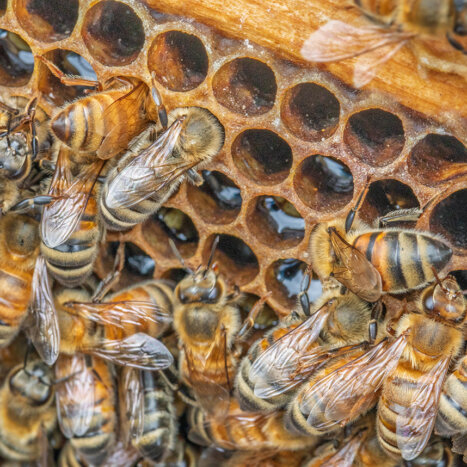
The honey bee colony is a masterpiece of complex social organization, a society where every individual is born into a specific caste with a predetermined role. Within a single hive, you will find three distinct types of adult honey bees: a single queen, a few hundred drones, and tens of thousands of workers.
All three honey bee castes – queen, drone and worker – pass through four life stages: egg, larva, pupa and adult. However, the crucial factor is how their role is determined, which depends on a fascinating mix of mix of genetics and nutrition.
How Caste Is Determined
The differentiation between the three castes is not random; it is determined by the combination of two factors: fertilization and diet.
Genetic Determination (Sex Differentiation)
- Fertilized Egg (Female): Both the queen bee and the worker bees develop from fertilized eggs laid by the queen bee. They are both genetically female.
- Unfertilized Egg (Male): The drone bee is male and develops from an unfertilized egg.
Nutritional Determination (Queen Bee vs. Worker Bee)
Since the queen bee and worker bees start with the same genetics, their final role is determined entirely by what they are fed during the larval stage:
- The Queen Bee: A female larva destined to become a queen bee is fed an exclusive, rich diet of royal jelly – a glandular secretion from the worker bees – throughout its entire larval development. This superior nutrition activates the necessary biological pathways for a fully fertile, long-lived reproductive female.
- The Worker Bee: A female larva destined to become a worker bee receives royal jelly only for the first few days, after which its diet is switched to a mixture of pollen and honey (or “bee-bread”). This diet results in a smaller, sterile female with specialized structures for performing hive labor.
Roles and Lifecycles of the Three Castes
The Heart of the Colony – the Queen Bee
The queen bee is the only fertile female and the largest member of the colony. Her entire existence is dedicated to two vital functions:
- Reproduction: She lays up to 2,000 eggs per day during peak production, ensuring the continuity and growth of the colony. She mates with multiple drone bees during early nuptial flights and stores all the sperm she needs for the duration of her long life (averaging 2–3 years).
- Social Cohesion: She produces queen substance (a pheromone) that maintains the hive’s social structure, prevents swarming and suppresses the worker bees’ reproductive capabilities. The queen bee never leaves the hive, except for her mating flights or when leaving with a swarm.
The Engine of the Hive – the Worker Bee
Worker bees are sexually undeveloped females who form the bulk of the colony’s population (1,500 to 50,000 members). They are the smallest, but their life is an intense, age-based progression of duties:
| Age (Approx.) | Role (Duty Type) | Tasks Performed |
| Days 1–18 | House bee (indoor duty) | Cleaning cells, feeding young larvae (nurse bee), secreting wax for comb construction, ventilating and cooling the hive, guarding the entrance, feeding the queen bee and drone bees |
| Days 18–45+ | Field bee (outdoor duty) | Foraging for nectar, pollen, water and propolis (bee glue) and ripening nectar into honey in their honey stomach |
Worker bees live only about four weeks during the active summer season due to their intense labor and high extrinsic mortality from foraging, but they can live up to 8–10 weeks (or even months) during the less active winter season.
The Male Contributor – the Drone Bee
Drone bees are the male bees and are stouter and larger than the worker bees.
- Sole Function: Their only function is to impregnate a virgin queen bee during her nuptial flight, a task they cannot perform until about 10 days of age.
- Hive Life: They are physically incapable of doing any ordinary hive work, such as foraging or caring for brood. They go out only in the midday warmth, primarily to congregate in drone bee congregation areas for mating.
- Fate: A drone bee dies immediately after mating. Those who don’t mate are expelled from the hive by worker bees in the late fall or winter to conserve resources, as they consume triple the food of a worker bee and serve no purpose outside the breeding season.
The interdependence of these three castes – the queen bee for procreation, the worker bees for sustenance and defense, and the drone bees for genetic diversity – create nature’s most efficient and resilient communities.
Every colony is a true marvel of teamwork, supporting the beekeeping practices behind the honey that becomes Nate’s Honey.
Read MORE