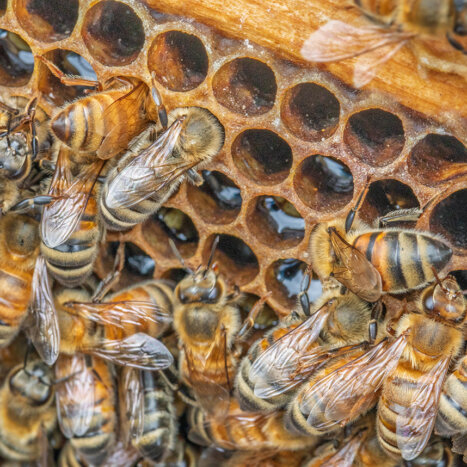

Honey bees have captivated human imagination for millennia, showing up in art, religion and culture as profound symbols of everything from royalty to resurrection. Our long relationship with the honey bee – stemming from the functional benefits of honey, wax and crop pollination – has led to a deep, cross-cultural aesthetic appreciation for this tiny insect.
From the earliest known cave paintings to modern art installations, the honey bee’s influence is seen in diverse cultures across Europe, Asia and the Americas. The honey bee motif often acts as a bridge between function and profound symbolism, evolving from a simple communication about resource collection to complex representations of societal ideals.
The Importance of Honey Bees and Ancient Rulers
The honey bee’s social structure and ability to produce valuable resources made it a potent symbol of wealth, health and order, especially in ancient societies.
The Pharaonic Symbol
In Ancient Egypt, from about 3500 BCE, carvings of honey bees and their hieroglyphs were incorporated into significant archaeological sites and royal titles. The honey bee was so highly regarded that its hieroglyph was part of the title of the king of Upper and Lower Egypt and served as a symbol for the organization of society and the wealth it generated.
Beyond royalty, honey was considered valuable even in the afterlife. In the famous tomb of the pharaoh Tutankhamun, honey was found, reflecting its perceived value to the pharaoh in the next world. Additionally, mummies were sometimes embalmed in honey, and sarcophagi were often sealed with beeswax. This level of abstract thinking suggests that honey bees and their products were regarded as symbolic of the meaning of life and death.
The Napoleonic Emblem
Thousands of years later, Napoleon Bonaparte similarly embraced the honey bee motif to symbolize his empire’s desired values. He viewed the honey bee as a symbol of hard work, order and good health.
As a result, the golden bee became an important element of the First French Empire’s imperial coat of arms. Napoleon employed considerable effort to incorporate the motif into French designs of the time, including tapestry, jewelry and architectural decorations (such as the Imperial Bee from the Coronation decorations in Notre Dame Cathedral). The honey bee was a visual metaphor for the values Napoleon wanted his empire to hold.
Honey Bees Appearing in the Americas
In the Americas, the relationship with honey bees was already highly developed before the arrival of European honey bees, revolving around native stingless bees Melipona beecheii.
The Mayan Gods
The deep relationship between humans and bees is also detailed in the Maya culture of Mesoamerica. The stingless bee was perceived as a sacred animal and a gift of the gods to the Maya people.
- Deities and rituals: The Mayans had a bee-representing god, Ah-Mucen-kab, who is often depicted in his temple landing or taking off, similar to how bees approach flowers. The god Hobnil was also the protector of beehives.
- Functional symbolism: Beyond honey, the wax from bees was fundamental for the production of gold and silver items using the lost-wax casting technique. Thus, for many pre-Columbian societies, the bees’ produce was the key that enabled them to communicate with the gods through ritual.
The Uwa People’s Song
In the east region of modern Colombia, the Tunebo (Uwa) people also hold stingless bees as sacred, believing they are daughters of the solar god.
Uwa people consider the bee their totem and perform the mythical song of the bees (mito cantado de las abejas) after harvesting honey. During the ritual, tribe males mimic the flight of the bees and sing the myth until dawn. The persistence of this mythical song is strong evidence of the bee’s continuous prevalence and profound religious importance in their culture.
Bees and the Modern Aesthetic
Today, the bee continues to inspire artists, often bridging the gap between scientific concern and aesthetic beauty.
The Musical Aesthetic
The distinctive sound of the bee’s flight – the droning – has been a shared musical influence for centuries, evolving into musical genres.
- The classical interpretation: The most recognizable classical example is Nikolai Rimsky-Korsakov’s orchestral interlude, Flight of the Bumblebee, written in 1899. The piece uses rapid, relentless notes to auditorily depict the “skittish” and “frenetic” movement of the foraging bee, capturing the insect’s kinetic energy.
- The modern collaboration: In 2015, the bee’s sound was used for a co-species music creation called ONE. Musicians improvised in the key of C to a live audio feed of 40,000 bees and their hive sounds. This complex inter-species composition, rooted in the bee’s low-frequency drone, was the official soundtrack to the award-winning UK Pavilion at the Milan Expo, raising global awareness of the bee’s plight.
The Architectural Ideal
The beehive’s hexagonal geometry has also provided enduring inspiration for human architecture and design.
- Ancient domes: Early examples include the Celtic “Beehive houses” and the Mycenaean “Treasury of Atreus” tomb in Greece, which visually resembled the ancient skep beehives.
- Modern efficiency: In the modern era, the hexagonal form inspired Frank Lloyd Wright’s Hanna-Honeycomb House and is the key geometric principle behind Buckminster Fuller’s geodesic dome typology. The hexagon’s confirmed mathematical efficiency – enclosing the greatest amount of space with the least amount of material – is the core reason the bee’s design continues to inspire modern engineering and architecture today.
The enduring and evolving presence of bees in art and culture demonstrates a deep-seated human appreciation that moves far beyond the functional benefit of sweetness, establishing the bee as a universal symbol of order, resilience and vitality. This same respect for the bee’s integrity is what drives commitment to relentless quality in Nate’s Honey.
Read MORE