In October 2025, a distant cousin of the European honey bee made history in Peru. Stingless bees native to the Peruvian Amazon became the first insects in the world to be recognized as legal subjects with rights. This landmark decision acknowledges the ecological and cultural importance of these bees, long relied upon by Indigenous and local communities and essential to the health of the Amazon rainforest.
Stingless bees (tribe Meliponini) are a keystone species in the Amazon, responsible for pollinating an estimated 80% of flowering plants in the region. Their pollination services support both wild ecosystems and agricultural crops such as cacao, avocado and coffee. Despite their outsized role in maintaining biodiversity and food systems, stingless bees – like many pollinators – have historically been overlooked in conservation and policy efforts.
What Makes Stingless Bees Different from Honey Bees
Although stingless bees lack the iconic stinger of the European honey bee (Apis mellifera), they share many similarities. Both are highly social insects that live in complex colonies and produce excess honey that can be harvested by humans. Stingless-bee honey has been documented as being nutritionally rich and, in some cases, associated with natural wellness benefits.
Where stingless bees truly differ is in their hive architecture.
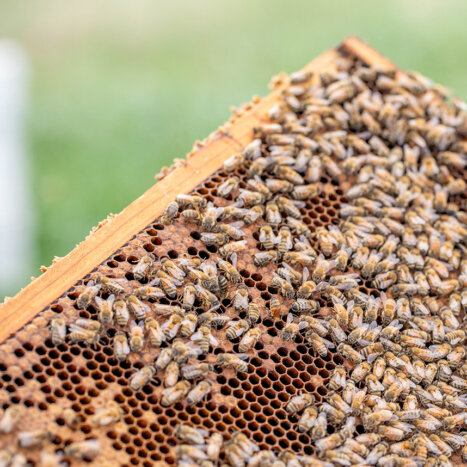
Honey bee hives are built with flat, vertical combs that house both brood and honey in the same structure. In contrast, stingless-bee nests are designed for defense and durability, compensating for the bees’ lack of a stinger. Their hives are:
- Constructed from cerumen, a composite material made of beeswax mixed with plant resins and sometimes soil or small particles
- Organized in spiral or clustered combs rather than flat sheets
- Structured with separate storage pots for honey and pollen located outside the central brood area
- Encased in thick outer batumen walls made of hardened resin mixtures
- Connected to the outside world through a narrow entrance tube that limits access to intruders
In short, honey bees store brood and food together in open combs, while stingless bees separate these functions and fortify their nests for protection.
However, stingless does not mean defenseless. Most stingless bees are about the size of a grain of rice, and they rely on alternative strategies to protect their colonies. Some species swarm intruders, crawl into sensitive areas such as nostrils or ears, or apply sticky plant resins to immobilize threats. Biting is also a common defensive tactic. These behaviors allow stingless bees to successfully defend their nests though the bees lack a venomous stinger.
What Legal Rights Mean for Bees
In Satipo, Peru, municipal ordinance passed by the Provincial Municipal Council formally recognizes stingless bees and their habitat as legal subjects. This means their interests can be represented by humans in court, and local authorities are obligated to respect, protect and enforce those rights.
The ordinance identifies several major threats to stingless bees and the ecosystems they depend on, including:
- Habitat Destruction and Degradation: land clearing, infrastructure development, forest degradation
- Loss of Native Flora and Biodiversity: food scarcity, ecosystem imbalance
- Climate-Related Stressors: temperature shifts, altered flowering cycles, extreme weather
- Poor Forest and Land Management Practices: unsustainable logging, land mismanagement
- Lack of Knowledge and Inadequate Decision Making: governance and knowledge gaps
Importantly, these are not just risks – they are now recognized as violations. The law provides a mechanism for accountability and intervention when harm occurs.
Granting legal rights to stingless bees is about more than protecting one group of insects. It represents a broader shift in how ecosystems are valued and protected under the law. By recognizing pollinators as rights-bearing entities, Peru has created a precedent that could influence conservation strategies worldwide – especially as pollinator populations continue to face mounting pressures.
Protecting bees means protecting forests, food systems and the communities that depend on them. In that sense, this ruling is a powerful step taken for global biodiversity.
Honey Bee Health at Nate’s Hives
Nate’s Hives cultivates more than 6 billion honey bees and 120,000 colonies in the U.S. Our work enables us to harvest the highest-quality, best-tasting Nate’s Honey, and honey bee health is foundational to our efforts. Supporting education and research through the Nate’s Hives Research Grant Program and implementing innovative management practices help ensure that pollinators – whether honey bees or their stingless relatives – can continue the vital work that ecosystems and agriculture depend on.
Because healthy bees mean a healthier planet.
Read MORE