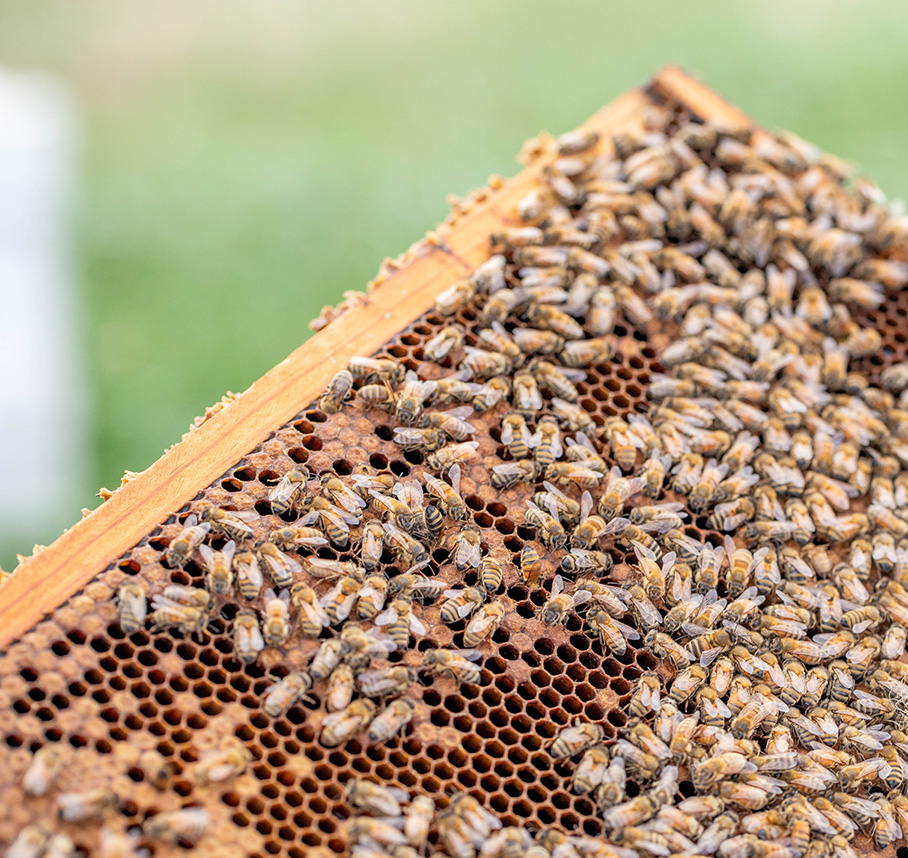
When most people think about running a successful business, they think about logistics, scaling up and making operations run smoothly. But at Nate’s Honey, we know the real secret to efficiency was perfected long ago – right inside the hive. The six-sided hexagon of the honeycomb is one of nature’s greatest engineering marvels, perfectly designed to save precious wax while building a strong, sturdy home for the colony.
Managing an agricultural footprint across 120,000 colonies at Nate’s Hives takes a deep respect for the natural systems that keep our honey bees healthy and productive. When you look at the mix of pure instinct and smart physics behind how honey bees build their comb, it shows the exact kind of naturally streamlined efficiency we strive for across our entire operation.
The Math behind the Hexagon
From an engineering standpoint, the regular hexagon is nature’s ultimate space-saver. It allows honey bees to tile a flat surface with a repeating shape without leaving a single gap or overlapping an edge. Whether you’re an ancient mathematician or a modern architect, the math is clear: The hexagon gives you the absolute most storage space using the least amount of material to build the walls.
For honey bees, this smart geometry comes down to saving energy and precious resources. Making beeswax takes a massive amount of metabolic energy from a colony. By building in a hexagonal grid, honey bees unlock two huge advantages:
- Maximum Volume: They fit the absolute most storage units possible into a tight area.
- Minimum Perimeter: They use the least amount of precious wax to build strong cell walls.
Why It Matters: Charles Darwin highlighted the remarkable efficiency of honeycomb construction, suggesting that natural selection could favor colonies that used wax resources more effectively
How Hexagons Actually Form
While the raw efficiency of the six-sided cell is obvious, how honey bees actually make them is a fascinating blend of natural instincts and physics.
1. The Pull of Surface Tension
Believe it or not, honey bees don’t actually start out building hexagons! They begin by building round, circular cylinders. As thousands of honey bees work shoulder-to-shoulder, their collective body heat warms up the hive, softening the beeswax. At that point, physical forces such as surface tension help shape the softened wax, working alongside the bees’ construction behaviors to produce the familiar hexagonal pattern.
2. Teamwork and Environmental Cues
Physics alone doesn’t tell the whole story, though – the honey bees’ own hands-on craftsmanship is vital. For that smooth hexagonal grid to form, those initial round cells have to be packed together perfectly from the very start, with each cylinder surrounded by exactly six neighbors.
Honey bees pull off this spatial perfection through decentralized teamwork called stigmergy. Think of it as an inherited game of follow the leader, where individual worker bees make simple decisions based on the work their hive-mates just finished:
- The Building Loop: Worker bees consistently start the base of a new cell right in the groove between two existing ones.
- Precision Built In: Honey bees use their antennae like tiny, super-precise tape measures. In fact, the variation in natural cell size is a mere 2.1% – matching the tight, uniform precision found in the honey bees’ own anatomy.
- The Cost of Errors: When a rare building mistake happens and a cell ends up surrounded by five or seven neighbors instead of six, the final cell shapes itself to match that exact number. This proves that the honey bees’ behavioral blueprint is what sets the stage for physics to do its magic.
Bringing Natural Design to Life
Hexagonal geometry is one of nature’s favorite shortcuts for strength, showing up everywhere from insect eyes to stunning rock formations like the Giant’s Causeway. Today, human engineers even copy this exact layout to build super-strong, lightweight materials like aerospace panels and carbon nanotubes.
At Nate’s Hives, taking a closer look at how honey bees work together reminds us why we’re so passionate about protecting them. Caring for our hives means investing in bee health research and giving our pollinators the optimal environments they need to thrive. When we give our colonies the right support, they can focus on executing the brilliant natural engineering that brings the highest-quality, best-tasting 100% pure honey to your family’s table.
Read MORE