To really appreciate the world of honey bees, it helps to see it as they do. While both humans and honey bees rely heavily on vision, there are two very different versions of reality. For honey bees, sight isn’t just about spotting objects – it’s a powerful tool for navigating a constantly changing landscape of flowers and making smart decisions about where to invest their energy.
A Different Kind of Color Vision
Honey bees have Amazon, meaning they have three types of photoreceptors in their eyes – as we do. But the similarities mostly stop there.
Humans see light in wavelengths from about 390 to 750 nanometers (nm). With honey bees, that difference is roughly 300 to 650 nm. Honey bees can see ultraviolet (UV) light, which is completely invisible to us, but can’t see red.
Their Three Types of Photoreceptors Are Tuned to:
- Ultraviolet (UV): Helps them detect floral patterns and nectar guides
- Blue: Important for recognizing objects and navigating
- Green: Crucial for detecting motion and sharp contrasts
Rather than a focus on fine detail and rich color as with humans, honey bees’ vision can identify contrast, patterns and movement.
Honey bees also have compound eyes made up of thousands of tiny units called ommatidia. This makes them especially good at detecting rapid motion and changes in light – perfect for flying quickly through fields while scanning for flowers and staying stable in midair.
Nature’s Landing Lights
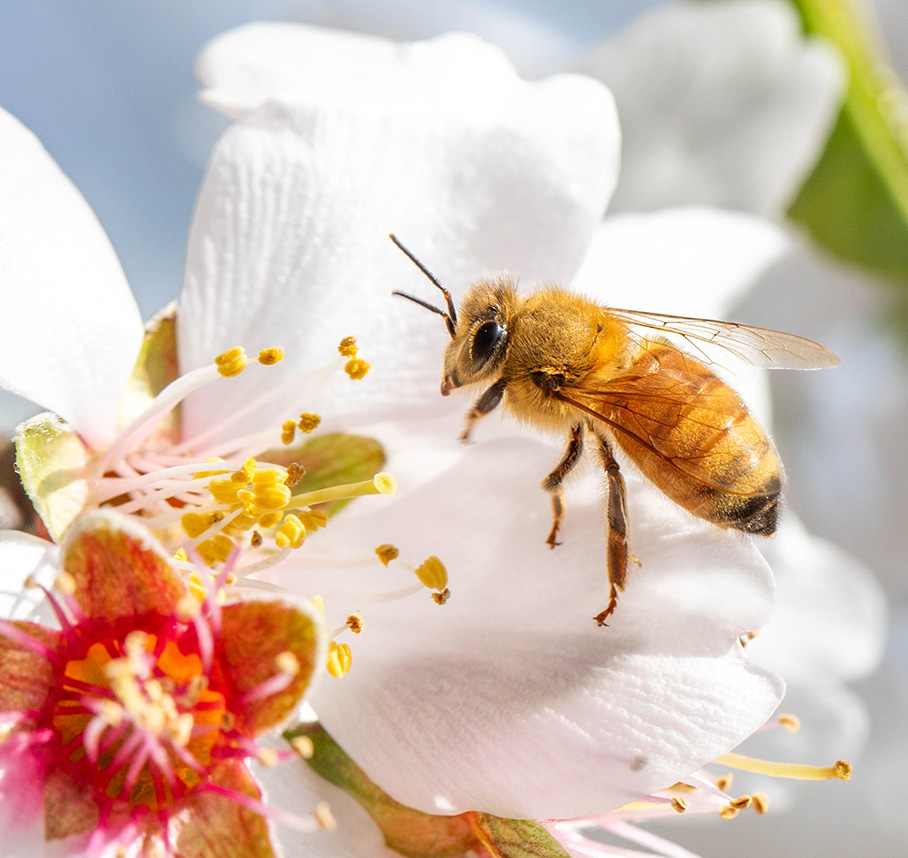
Many flowers have evolved specifically to stand out to honey bees and other pollinators. What might look like a plain yellow petal to us could appear to a honey bee as a bold pattern with a glowing UV “bullseye” in the center.
These ultraviolet patterns, called nectar guides, direct honey bees straight to the reward. It is this precise navigation that allows bees to forage efficiently from nectar‑rich blooms – an essential first step in the natural process that ultimately produces the 100% pure, raw & unfiltered honey in every bottle of Nate’s Honey.
This arrangement benefits everyone. Honey bees waste less energy searching for nectar, and plants increase their chances of being pollinated. Over time, flowers that attracted honey bee vision more effectively were more likely to reproduce. The result? A beautifully fine-tuned visual communication system.
And honey bees don’t judge just color. They process color as well as shape, symmetry, edges and contrast. Something that looks subtle or decorative to us might be a bright, flashing sign to a honey bee.
Smart Foragers with Sharp Eyes
Honey bee vision isn’t just about perception; it’s tied closely to learning and decision making.
Honey bees are especially sensitive to how different flowers appear within their line of vision. When flower colors are clearly distinct from one another (in ways honey bees can detect), honey bees tend to stick with one type. This “flower fidelity” helps them forage more efficiently, because they don’t have to relearn how to handle each new flower they visit.
They’re also impressive learners. Honey bees quickly associate certain colors and patterns with nectar rewards. If a flower consistently offers high sugar content, honey bees remember that. If it doesn’t, they adjust.
Interestingly, honey bees can even behave in ways that resemble loss aversion, a concept from human behavioral economics. If a flower that once provided a good reward suddenly becomes less “profitable,” honey bees don’t immediately give up on it. They often need several disappointing experiences before fully switching strategies. That suggests their decisions aren’t just automatic reflexes; they involve evaluation and memory.
Vision as a Survival Tool
For a honey bee, every foraging trip involves a balance of energy gained and energy spent. Flying takes effort. So does searching. And the outside world carries risks.
Honey bees’ visual apparatus acts like a high-speed filter. It helps them quickly spot promising flowers, ignore poor options, land accurately and move on, efficiently. The ability to see UV patterns, detect contrast against green foliage and track motion allows them to make fast, accurate decisions in a constantly changing environment.
Ultimately, honey bee vision doesn’t match ours – and it isn’t meant to create a beautiful, colorful world the way we experience it. It’s designed for performance.
What looks to us like a peaceful meadow full of flowers is, to a honey bee, a highly structured and information-rich marketplace. Every bloom carries signals. Every pattern means something. And through a visual system tuned to ultraviolet, blue and green light, honey bees navigate that marketplace with remarkable precision.
Read MORE