Launching North America’s First Public Genomic Prediction Service for Honey Bees

Launching North America’s First Public Genomic Prediction Service for Honey Bees
Every drop of honey begins with a healthy, thriving hive – and at the heart of every strong colony is a resilient queen. Through the Nate’s Hives Research Grant Program, we fund forward-thinking scientists who are developing practical, data-driven solutions to protect our pollinators and empower the beekeeping community.
We are thrilled to spotlight an initiative out of Purdue University that was a recipient of our 2026 grant program: a project aimed at launching North America’s very first publicly accessible, scientifically validated genomic prediction service for honey bees. By bringing modern agricultural genetics into apiculture, this research is paving the way for a healthier, more resilient future for beekeeping.
Meet Dr. Brock Harpur & the Purdue Entomology Team
This project is led by Dr. Brock A. Harpur, Associate Professor in the Department of Entomology at Purdue University and lead investigator at the the Harpur Lab. Dr. Harpur’s lab bridges the gap between molecular genomics, evolutionary biology and practical apiculture. They examine how honey bee genomes evolve and apply ‘omics data directly to help beekeepers manage healthier, more resilient stocks.
Joined by key team members, including extension specialist Krispn Given and a dedicated team of quantitative geneticists and researchers, the Harpur Lab is pioneering the use of Genomic Selection (GS) in honey bees, adapting tools long used in livestock and crop improvement to address the urgent threats facing pollinators today. Genomic selection identifies naturally occurring traits within honey bee populations and does not involve genetically modifying bees.
Moving Beyond Traditional Selection
Honey bees contribute more than $18 billion annually to U.S. agriculture through pollination services, yet average annual colonies are experiencing losses around 30%. A major driver of these losses is the invasive parasite Varroa destructor, along with secondary pathogens and environmental stress.
For decades, beekeepers have selectively bred honey bees for desirable traits like disease resistance, honey production and gentleness. However, traditional breeding relies heavily on visual assessments, trial-and-error or single-marker genetic tests. These traditional methods struggle to predict complex, low-heritability traits that depend on hundreds or thousands of genes working together.
While cattle, swine and crop industries have revolutionized breeding using Genomic Selection – evaluating an individual’s entire genome to predict its breeding value – the beekeeping industry has limited access to an affordable, scaled genomic prediction framework.
Supercharging Bee Breeding with Genomic Selection
Rather than looking at just a few genetic markers, Genomic Selection uses genome-wide sequencing markers across a reference population to calculate Genomic Breeding Values (GBVs). This allows researchers to accurately predict how a queen’s offspring will perform in key areas – such as suppressing Varroa mites or producing honey – before investing entire seasons into colony evaluations.
Building on successful preliminary work in Indiana that demonstrated significant reductions in fall mite loads and improvements in overwinter survival, Dr. Harpur’s project is scaling this technology nationwide.
The Scientific Journey
With support from the Nate’s Hives Research Grant, the Purdue team is executing a three-stage plan to translate complex laboratory genomics into a practical tool for queen breeders:
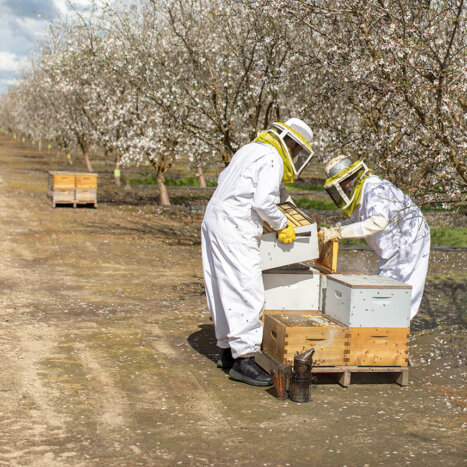
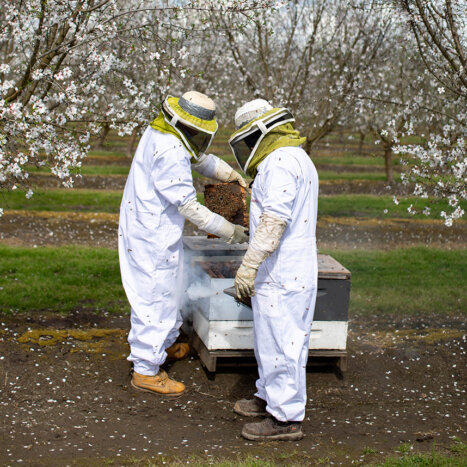
Establishing a National Reference Panel: Each year, the team sources 100 queens from commercial breeding operations across diverse U.S. climate regions. Managed under standardized conditions at Purdue research apiaries, these colonies undergo uniform health evaluations, alcohol washes for Varroa tracking and full-season phenotyping. Pooled DNA sequencing builds a robust national genetic baseline.
Connecting Genomes to Field Performance: The researchers collect matched genomic and phenotypic data focused on three vital metrics:
- Fall Varroa Mite Levels (evaluated via standardized alcohol washes)
- Honey production (weighed using precision scales at harvest)
- Annual queen survival (monitored across four distinct seasonal checkpoints)
Advanced statistical mixed models calculate precise GBVs, allowing the team to isolate true genetic potential from local environmental factors.
Launching a Public Genomic Prediction Service: The ultimate goal is delivering an affordable, public-facing testing service through Purdue’s diagnostic lab network. Beekeepers and queen breeders will be able to submit simple worker samples and receive comprehensive genetic reports. These reports are intended to rank stock based on mite resistance, survival potential and honey production – helping breeders make more informed decisions about which queens to propagate.
Why This Matters for the Future of Beekeeping
By shifting honey bee breeding into a data-driven, transparent and reproducible framework, this project empowers breeders to propagate superior, locally adapted and disease-resistant queens faster than ever before.
Accelerating genetic gains for Varroa resistance may help reduce reliance on chemical miticide treatments, improve colony survival rates and enhance overall commercial apiary profitability.
At Nate’s Hives, we are proud to partner with Dr. Brock Harpur and Purdue University. By funding cutting-edge scientific initiatives through our grant program, we are helping build a resilient infrastructure that keeps our pollinators healthy and our food system secure.
Read MORE